
Beneath the Bothnian Sea – Exhibition in English
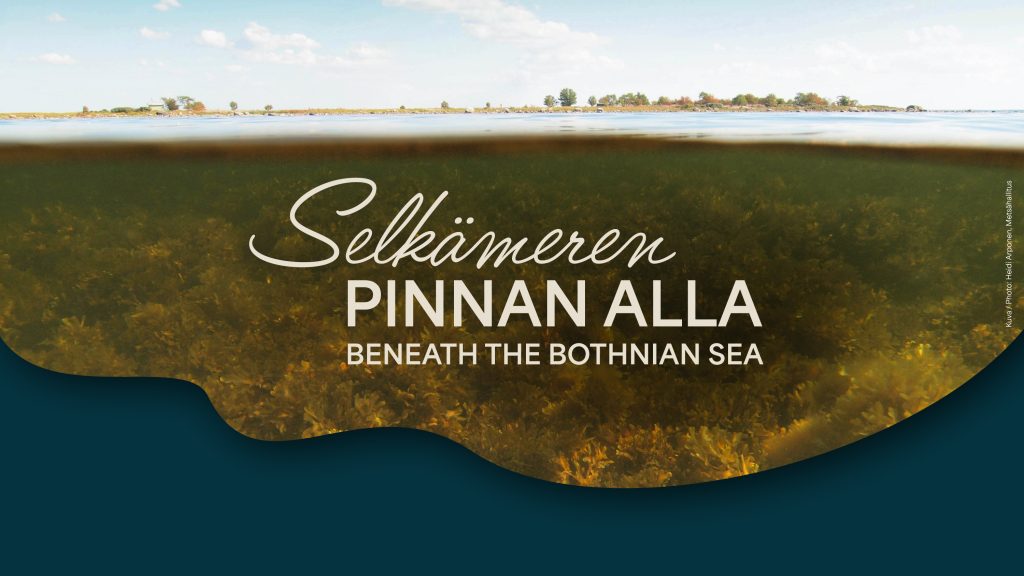
The Bothnian Sea is a shallow, low-salinity part of the Baltic Sea between Finland and Sweden. The archipelago is narrow, so the open sea begins close to the coast. This is one of the windiest sea areas in Finland, and the water is often clear. In winter, the ice cover is important for many species, such as the Baltic ringed seal.
Low salinity and the north–south gradient shape the biota. The Bothnian Sea is a unique mix of freshwater and saltwater species. Large rivers, such as the Kokemäenjoki River, bring freshwater and sediment into the sea. The seabed varies from rocky shores and boulder fields to shallow bays and soft muddy bottoms – each seabed type creates its own habitat.
This environment is home to fascinating species and communities, from open rocky reefs to sheltered coves. In the exhibition, you will also learn about research on the Bothnian Sea and the challenges it faces, such as eutrophication and cyanobacterial blooms, as well as measures to protect the marine environment. The Bothnian Sea National Park, established in 2011, and other protected areas help to safeguard marine life.
Welcome to dive beneath the surface!
Hard Bottoms
On hard rocky and stony seabeds, as well as on underwater reefs, live species that must be able to attach firmly to rock surfaces to withstand the force of waves. Underwater reefs are rocky or bedrock formations that rise clearly above the surrounding seabed.
-
Below the bladderwrack meadows, at depths of 2–20 metres, begins a zone dominated by red algae. Red algae can photosynthesise even in deep water because they use the wavelengths of light that penetrate furthest. On the outer reefs of the Bothnian Sea, red algae can be found at depths of more than 20 metres thanks to clear water and strong water exchange.
Clawed fork weed is the largest red alga in the Baltic Sea and has a coral-like appearance. Its branches end in forked tips, and its dark red colour may become paler in shallow water. It attaches to hard surfaces with finger-like holdfasts, but it can also form free-living mats. Its dense, bushy growth provides shelter and food in the dim depths, where few other algae can survive.
-
Saduria entomon is a translucent crustacean with a flattened body and a segmented dorsal plate. At up to 10 centimetres in length, it is the largest invertebrate in the Baltic Sea. It can live for about three years.
It lives on deep, soft seabeds where it can burrow. Often, only the posterior end sticks out of the sand. It moves slowly along the seafloor or swims upside down.
It is a solitary predator and scavenger, feeding on dead fish and even on its own young. It tolerates a wide range of salinities and can survive in low-oxygen conditions. It is a relict species – a survivor from the end of the last Ice Age that remained in the Baltic Sea. -
Sea mat is a bryozoan that forms pale, thin and lace-like colonies on hard surfaces, such as blue mussel shells, bladderwrack and stones. A colony is made up of very small individuals, each about 0.5 millimetres long, and a long-lived colony can grow to the size of a human hand. All individuals share the same genetic material and are therefore clones of one another.
Each individual secretes a hard, calcareous exoskeleton around itself, which anchors it to the surface and to its neighbours. From inside this structure, the sea mat extends a ring of feeding tentacles, which it uses to catch tiny organisms for food.
-
Among bladderwrack, alongside fish, live many small marine invertebrates such as Idotea balthica, a crustacean. Like other crustaceans, it sheds its exoskeleton as it grows. It is something of a chameleon: the colour of its oval, flattened and segmented body varies depending on its surroundings.
At the end of summer, young individuals hide and feed in the bladderwrack zone. Males are mostly found among the fronds, while females stay closer to the base. The tannins in bladderwrack do not interfere with its digestion – it is specially adapted to feeding on this alga.
-
The bay barnacle is a crustacean that spends its entire adult life attached to a surface. As it grows, it can turn in place to face the direction of water currents. It feeds by filtering particles from the water using six pairs of feathery legs.
It lives inside a white, calcareous shell. It attaches firmly to hard surfaces such as rocky shorelines at the waterline, blue mussel shells, boat hulls and piers. Individuals usually grow close together, forming a continuous, rough grey layer. The bay barnacle is a harmful invasive species that arrived in Finland in the 19th century with ships.
-
A typical species of deeper rocky seabeds in the Bothnian Sea is the red alga known as black siphon weed. This coarse and sturdy alga has a feathery appearance and grows in tuft-like clumps on the seafloor, or attached to other algae or blue mussels.
These perennial algae range in colour from deep red to reddish brown, and when dried they are almost black. Under a microscope, the surface cells of the filaments resemble human bones. When washed ashore and decaying, black siphon weed has a distinctive smell caused by bromine compounds. These compounds are thought to protect the algae from being eaten by animals.
-
Bladderwrack is the largest macroalga along our coast. It is a brownish-green, branching alga with air bladders near the tips of its fronds. In sheltered waters, these bladders help the alga rise towards the light. It attaches to hard seabeds, stones or rock using a holdfast and finger-like structures. In the Bothnian Sea, it can grow as deep as eight metres thanks to clear water.
Bladderwrack can live for more than ten years and is a key species in the Baltic Sea. Its extensive meadows provide food, shelter and attachment surfaces for many organisms, and even storm-formed wrack banks along the shore are important habitats. It thrives in clear, nutrient-poor waters, and its decline is a sign of eutrophication and reduced light conditions.
-
Blue mussels live at depths of 3–30 metres, both in light and darkness, and thrive on wave-washed shores. They attach themselves to rocks and other hard surfaces with strong, fibrous threads, but they can also move using their muscular foot. The elongated shell turns bluish at around three years of age, and its colour can vary from brown to black or yellow.
Blue mussels filter their food from the water and can filter several litres of water each hour. Dense mussel beds provide shelter and food for many other organisms. Living for up to 15 years, the blue mussel reflects the condition of the Baltic Sea, as pollutants and environmental toxins accumulate in its body.
Sand Bottoms
Terrestrial sand ridges continue underwater, forming sandy seabeds. In the Bothnian Sea, sandy bottoms are not particularly common overall, but extensive underwater sand areas are typical particularly off Luvia, Yyteri (Pori) and Merikarvia. These sandy areas can extend to considerable depths, sometimes beyond 20 metres. On sandy bottoms, the substrate is in constant motion.
-
The lagoon cockle can be recognised by its pale, ridged shell with a finely toothed margin. Seen from the side, the strong and rounded shell has a heart-shaped form. Young cockles attach themselves to algae with fine threads or crawl among aquatic plants. As they mature, they settle on the seabed and, as adults, live burrowed in sandy bottoms.
Lagoon cockles filter their food directly from the water, but they may also feed on organic material that has settled on the seabed. When threatened, the lagoon cockle can rapidly contract its foot and hop along the seabed.
-
Vascular plants such as spiral tasselweed are anchored to sandy bottoms with their roots. Rooted aquatic plants help stabilise the seabed in wave action and provide habitats for fish and invertebrates. Their meadow-like stands are visible in aerial photographs as darker patches.
Spiral tasselweed is an unassuming, grass-like submerged plant that grows entirely underwater. In late summer, it can be recognised by its spiral-twisted fruit stalk, which gives the species its name. This resilient little plant thrives on open sandy and gravelly bottoms in the outer archipelago.
Soft Seabeds
The Bothnian Sea has extensive shallow bays, such as Viasvesi Bay and Preiviiki Bay. In these shallow and sheltered areas, the seabed consists of sand, mud, or a mixture of both.
As a result of land uplift, shallow bays with soft or muddy bottoms gradually become separated from the sea, forming fladas and, later, gloe lakes. A flada is a brackish water basin that still has a narrow connection to the sea. Over time, the connection closes and the flada develops into a gloe lake with no link to the sea. In Pori, fladas and gloe lakes occur, for example, on the Kuuminainen Peninsula.
-
Holly-leaved naiad is an olive-green, large, delicate submerged plant that can reach almost to the water surface. It is profusely branched and often spiny, with leaves arranged in opposite pairs or whorls. This annual plant is rooted in shallow, soft seabeds and forms extensive, bush-like stands, especially in fladas and gloe lakes.
Holly-leaved naiad requires a lot of light and prefers clear water. Eutrophication, shoreline development and dredging have led to its decline. Its seeds, which are heavier than water and sink, are dispersed by birds and fish, and in winter also by shoots that become frozen into the ice.
-
In fladas and gloe lakes, the water is often clear and warmer than in surrounding areas, creating a distinctive community of aquatic plants. Stoneworts, such as coral stonewort, stabilise soft bottoms, slow water flow and filter nutrients, helping to keep the water clear. Their underwater meadows provide shelter and food for fish larvae and juveniles and invertebrates.
Coral stonewort is a large and robust alga. Its main colour is green, but the tips may turn orange-red. The alga has a spiky appearance, with a thick main axis and stout side branches anchored to soft bottoms by root-like filaments.
-
On the soft bottoms of shallow bays, dense jungles of vascular plants such as Eurasian water-milfoil can develop. Eurasian water-milfoil is fast-growing and highly adaptable, which allows it to form large stands entirely below the water surface. Only its small, reddish flower spikes emerge above the surface in spring or autumn. The plant can grow up to 1.5 metres tall and has benefited from eutrophication along the Finnish coast.
Eurasian water-milfoil looks like a long, soft bottlebrush: the stem is reddish, and finely divided leaves grow in whorls around it. When lifted from the water, the leaves collapse against the stem. The species is also popular as an aquarium plant.
How to Study the Bothnian Sea
You can easily explore the species of the Bothnian Sea while walking along the shore, turning over shoreline stones, and using a simple water viewer. A water viewer can be made from a bucket or a plastic tube with a transparent bottom. With a simple hand net made from wire and mesh, you can collect small animals living in the water. A garden rake helps reveal plants in shallow bays. By snorkelling, you can observe algae and invertebrates and collect them carefully with tweezers or forceps, storing them in a jar or a reusable mesh bag.
Seabed mud can be lifted with a shovel and rinsed through a sieve, making bottom-dwelling animals visible. Species identification is easiest in a light-coloured container filled with water, using tweezers and a hand lens for closer inspection. Knowing the type of seabed and typical depths, as well as comparing similar local species, makes identification easier. Online resources can help, such as the Baltic Sea section of LuontoPortti.
Only small samples should be taken, and animals must always be returned to the sea. Protected or endangered species must not be collected, and habitats must not be damaged.
Enjoy your explorations!
-
When information is needed about seafloor species and habitats, or even shipwrecks that sank long ago, a research diver can be sent underwater to measure, document, and collect samples.
Studying the seafloor by diving is demanding work. Humans need special equipment to work safely underwater. A diver uses a scuba tank and regulator for breathing, a weight belt and buoyancy control device to maintain balance, and fins to move through the water. A diving mask improves visibility, and a warm diving suit protects against the cold waters of Finland. A depth gauge or dive computer provides information such as depth and dive time.
Research equipment must also be designed for underwater use. Observations are recorded with a pencil on waterproof paper. Samples are collected with tweezers and stored in jars or mesh bags. Study sites are documented with an underwater camera. Divers may also carry measuring tapes, other measuring tools, and a powerful flashlight, as the seafloor is often dimly lit.
When studying underwater vegetation or animal species that remain attached to the seabed, researchers often use a method called a transect survey. A measuring line is laid along the seafloor, and the diver follows it while recording plant and animal species, their abundance, and environmental conditions. Samples are collected from species that cannot be identified by sight alone. This method has also been used to study the biodiversity of the Bothnian Sea as part of the VELMU mapping programme.
Using ordinary compressed air, a research diver can usually dive to depths of about 30 to 40 metres. Very shallow fladas and sheltered bays can also be surveyed without scuba equipment. Diving at depths greater than 50 metres, such as to shipwreck sites, requires specialised equipment and breathing gas mixtures.
-
Different environmental factors determine which habitats suit different plant, algal and animal species. In the Bothnian Sea, species distribution is influenced by salinity, seabed type, depth, temperature, light availability, and coastal exposure – meaning its openness, orientation and slope.
Because the Bothnian Sea is shallow and its seabed is highly varied, many different types of habitats are formed. These include hard rocky and stony bottoms, underwater reefs, wave-exposed and mobile sandy bottoms, as well as soft and sheltered muddy seabeds. Open, wave-swept rocky reefs support very different communities from those found in protected, shallow bays with soft muddy bottoms.
-
Marine areas are protected by safeguarding sites with especially high natural value and biodiversity. Protected areas include, for example, rocky reefs, eelgrass meadows on sandy bottoms, and sheltered fladas that support a rich variety of species. Not everything can be protected, so the focus is on key breeding, feeding and resting and staging areas. Biodiversity is often concentrated in shallow coastal zones, which are also under pressure from dredging, boat traffic and coastal development. However, the greatest threat is eutrophication, which is why protective measures are needed even outside designated protected areas.
Established in 2011, the Bothnian Sea National Park and Natura 2000 sites protect valuable marine habitats. In addition, EMMA sites – Ecologically Significant Marine Areas – represent the most important underwater marine areas along the Finnish coast, based on scientific research. In Satakunta, these include the Oura Archipelago, the Kokemäenjoki River delta, Preiviikinlahti, the Kuuminaisten Peninsula, Selkäpuori, and the outer archipelago of Rauma. These areas are vital for underwater biodiversity as well as for birdlife and fish populations.
-
The Bothnian Sea is threatened by eutrophication, invasive species, pollution, and changes driven by climate change. Excessive nutrient runoff is the greatest problem in the Baltic Sea: it increases the growth of algae and aquatic plants, clouds the water, and worsens oxygen depletion. Many deep basins are already completely anoxic. Harmful substances are also transported to the sea from land, and increasing marine traffic raises the risk of oil spills and the spread of invasive species.
Climate change is warming the water, strengthening cyanobacterial blooms and expanding seabed hypoxia. Increased rainfall lowers salinity, threatening many species, such as the blue mussel. At the same time, both species diversity and habitat diversity are declining. Threatened species include the migratory whitefish, the lesser black-backed gull, the Baltic ringed seal, and eelgrass meadows.
In addition, marine littering and underwater noise have increased, and more than 30 established invasive species are already found in Finnish marine waters.
-
The Bothnian Sea is part of the Baltic Sea, located between Finland and Sweden in the southern part of the Gulf of Bothnia. It is a shallow and low-salinity sea area: its deepest point is less than 300 metres, and salinity is about 0.5%. The archipelago is narrow or absent, so the open sea begins close to the shore. The Bothnian Sea is one of the windiest marine areas in Finland, and its waters are often clear. The winter ice cover is important for species such as the Baltic ringed seal.
Low salinity shapes the biota. There is a clear north–south gradient in the Bothnian Sea, where salinity, temperature and species composition change from south to north. The area forms a distinctive mix of freshwater and saltwater species, with communities adapted to its varied underwater environments.
Large rivers, such as the Kokemäenjoki River, bring freshwater and sediment into the sea. In many places, seabed conditions in the Bothnian Sea are often better than elsewhere in the Baltic Sea, but summer cyanobacterial blooms still indicate increased nutrient loading.
-
The region is characterised by a flat, gently deepening eastern side and a steep, irregular western side. In the sea areas surrounding Finland, the seafloor is highly heterogeneous on a small scale: different landforms and bottom materials can occur within short distances. Morainic and bedrock seabeds are common in the Bothnian Sea, as there is no extensive archipelago to shelter the coast.
The effects of the Ice Age are still clearly visible in the marine environment and coastline of the Bothnian Sea. Meltwater at the edge of the retreating ice sheet formed end moraines, which can be seen, for example, on the Kuuminaisten Peninsula in Pori and in the Oura Archipelago of Merikarvia. Underwater, Oura features long, parallel stony ridges, while near Rauma there are wave-shaped De Geer moraines.
Land uplift in the region is about 5–8 millimetres per year, continuously exposing new shoreline. As a result, the Bothnian Sea has many shallow muddy shores as well as fladas and gloe lakes that have gradually become separated from the sea.
-
Arponen, H., Brander, N. & Mäkinen, K. 2020. Itämeri Suomen luonnossa. Otava. Helsinki. 166 s.
itameri.fi-internetsivusto
Viitasalo, M., Kostamo, K., Hallanaro, E.-L., Viljanmaa, W., Kiviluoto, S., Ekebom, J. & Blankett, P. (toim.) 2017: Meren aarteet: Löytöretki Suomen vedenalaiseen meriluontoon. 2. painos. Gaudeamus Oy. 518 s.
Suomen Luonto -lehti 7/2025, Suuri Itämerinumero. 84. vuosikerta.
Metsähallitus merellä: EMMAt esittelyssä: Merenpohjien eliöyhteisöt – Pohjoinen Luvian saaristo-Säppi-Räyhät, https://metsahallitusmerella.blogspot.com/2020/07/emmat-esittelyssa-merenpohjien.html
Suomen Luonto, digi, Itämeren terveystarkastus, 19.9.2019, teksti: Riikka Kaartinen
Suomen Luonto, digi, Muuttuvan meren äärellä, 10.11.2021, teksti: Jessica Haapkylä